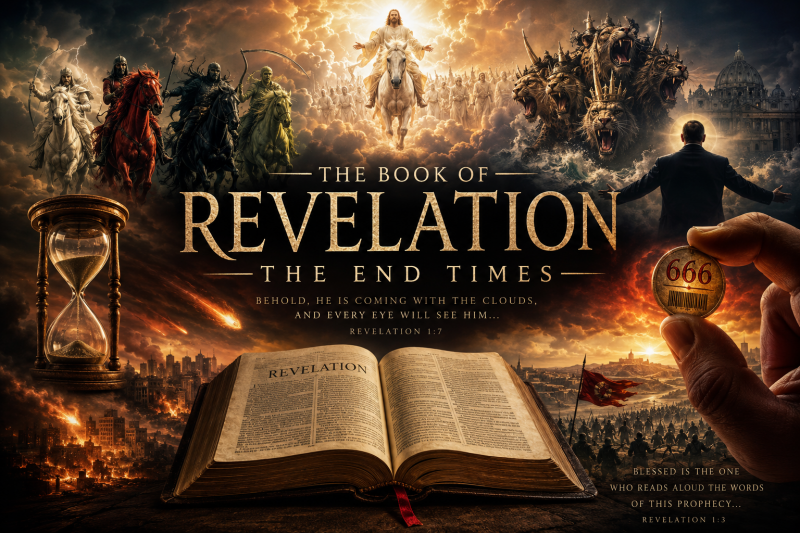
I asked ChatGPT this question.
What are the top questions people ask about end time events in the Bible.
1. When will the end times happen?
"Are we living in the last days right now?"
People want a timeline, but Scripture emphasizes readiness over prediction.
2. Who is the Antichrist?
"Is the Antichrist a person, a system, or both?"
"Will we recognize him when he appears?"
Key references: 2 Thessalonians 2, 1 John 2:18, Revelation 13
The Bible points to both a spirit of Antichrist and a coming figure. But what is AntiChrist? It is a person or attitude that opposes Jesus, acts as a false substitute to Him, an adversary of anyone of faith, and a deceiver who denies that Jesus is the Son of God.
3. What is the Rapture—and when does it happen?
"Will believers be taken before, during, or after the tribulation?"
There will be a day, in less than a second, when the following will take place.
1 Thessalonians 4:16–17 16 For the Lord himself will come down from heaven with a commanding shout, with the voice of the archangel, and with the trumpet call of God. First, the believers who have died will rise from their graves. 17 Then, together with them, we who are still alive and remain on the earth will be caught up in the clouds to meet the Lord in the air. Then we will be with the Lord forever.
While many people want to debate the timing of the Rapture, what we do know is this.
Jesus said in Matthew 24:36, However, no one knows the day or hour when these things will happen, not even the angels in heaven or the Son himself. Only the Father knows.
Yes, I do have a belief about the timing of the Rapture, but for this blog, I want to focus on one clear fact. There is a Rapture; it will happen, and we are to be prepared for it.
4. What is the Tribulation?
"How bad will it actually be?"
"Is it symbolic or literal?"
Key references: Daniel 9, Revelation 6–18
Yes, the Tribulation is real. And if you are asking how bad it will be, I think what we read in the Bible about it is the best the writers could do to express something beyond our comprehension. But to keep it simple, the Tribulation, especially the second half, will be beyond anything this earth has ever known.
5. What is the Mark of the Beast?
"Is it a physical mark, technology, or symbolic?"
"Can someone take it accidentally?"
Revelation 13:16–18
I don't think it is symbolic, since it is tied to one's ability to spend money. Without it, you will not even be able to buy a loaf of bread. It is something you will have to choose, and many people will do so blindly. But after the events they have experienced, which will have caused a worldwide economic collapse, making comparisons between current events and Biblical prophecy will be impossible.
6. What happens when Jesus returns?
"What will His return look like?"
"Will everyone see Him?"
Key reference: Revelation 19
This isn't speaking to the Rapture, but at the end of the Tribulation, Jesus will return to destroy the countries of this world that are determined to rule with an Antichrist attitude. Jesus and the armies of heaven will destroy the armies of this world at Armageddon, and He will rule in Jerusalem for the next 1,000 years.
7. What is the Millennium?
"Will Jesus literally reign on earth for 1,000 years?" Yes
Key reference: Revelation 20
Think of the Millennial Reign this way. While life is hard now, it is easy to sin. It will be easy to live a hopeful, wonderful life and be very hard to sin. Life will be the way it was supposed to be in the Garden of Eden.
8. What is the Final Judgment?
"What happens at the Great White Throne judgment?"
Key references: Revelation 20:11–15, Matthew 25:31–46
The wicked dead for all time will be brought before God for their final and eternal judgment. Everyone will be given the same sentence; hell, so the question that is often asked is, "Why?" God judges the wicked because He is just; they are accountable, grace was offered, and they ultimately rejected Him.
9. What happens to the Earth?
"Will the earth be destroyed or renewed?"
Key references: 2 Peter 3:10–13, Revelation 21–22
2 Peter 3:10 But the day of the Lord will come as unexpectedly as a thief. Then the heavens will pass away with a terrible noise, and the very elements themselves will disappear in fire, and the earth and everything on it will be found to deserve judgment. (Emphasis mine)
Here we see the heavens "pass away with a terrible noise" - many interpret this to mean some kind of atmospheric destruction. Then the elements, the very building blocks of life, will disappear in fire. Now the Scripture goes on to talk about a new heaven and a new earth. Not out of the realm of possibility, considering God created this world in 7 days. As to what it will look like or what it will be? Well, that is well within the realm of God's creative imagination and beyond ours to comprehend.
10. How should we live in light of the end times?
"What should Christians actually do with this information?"
"Is the goal to prepare, warn, or watch?"
Key references: Matthew 24:42–44, 2 Peter 3:11
Be ready to meet Jesus in a split second.
Live a life every day in submission to His will.
Be found working to build His Kingdom every day.
11. Are current events signs of the end?
"Do wars, Israel, or global events point to the end?" Yes
"How do we interpret 'signs of the times'?"
Key references: Matthew 24:6–8, Luke 21
Here, the challenge is distinguishing between general patterns and specific fulfillment. The wars, famines, attacks on Israel, and other global events that we see happening remind us that we are living in the end times. But when we see an event, such as the restoration of the nation of Israel in 1948.
12. Why is Revelation so hard to understand?
"Is it literal, symbolic, or both?"
"Why so much imagery?"
Key reference: Revelation (entire book)
Revelation uses apocalyptic language—meant to reveal truth, not confuse believers.
It reveals truth through symbols, not hides it.
John was speaking to a persecuted church under Rome. This language allowed him to speak about things without risking those who were reading it to persecution.
To pull back the curtain on the spiritual realm. What is happening beyond our world is also beyond our understanding. Apocalyptic language helps us connect the dots.
To create impact, not just information. Plain language informs. Apocalyptic language awakens.
John is not writing something new—he's finishing the story. Apocalyptic language ties everything together into one final picture.
To show that God wins—clearly and powerfully
Add comment
Comments